How to Comply with European Wine Labelling Regulations in 2026
EU Regulation 2021/2117 requires every wine sold in the European Union to display a nutritional declaration, a full ingredient list, and a QR code linking to that information digitally. The regulation has been in effect since December 2023 and applies to all wines from the 2024 harvest onward. Older vintages bottled before December 2023 remain exempt until stocks are exhausted. For a broader overview of how the regulation reshapes the industry, see The Future of European Wineries Post-December 8th, 2023.
If you run a winery or manage wine exports into the EU, this article answers the six most common compliance questions — so you can focus on making wine, not deciphering a 200-page regulation. If you prefer a quick-start checklist, our guide to compliance in 3 simple steps is a good companion piece.
What Information Must Appear on EU Wine Labels?
Under EU Regulation 2021/2117, every wine label must provide three categories of information: nutritional values, the ingredient list, and allergen declarations.
At minimum, the energy value in kilojoules (kJ) and kilocalories (kcal) per 100 ml must be printed on the physical label. The full nutritional declaration and ingredient list — including allergens such as sulphites, egg-derived fining agents, and milk-derived fining agents — can appear either on the physical label or through a digital link such as a QR code. For a deeper look at what counts as an additive under the regulation, see our guide to wine additives and labelling requirements.
Allergens must always be highlighted, regardless of whether the information is displayed physically or digitally.
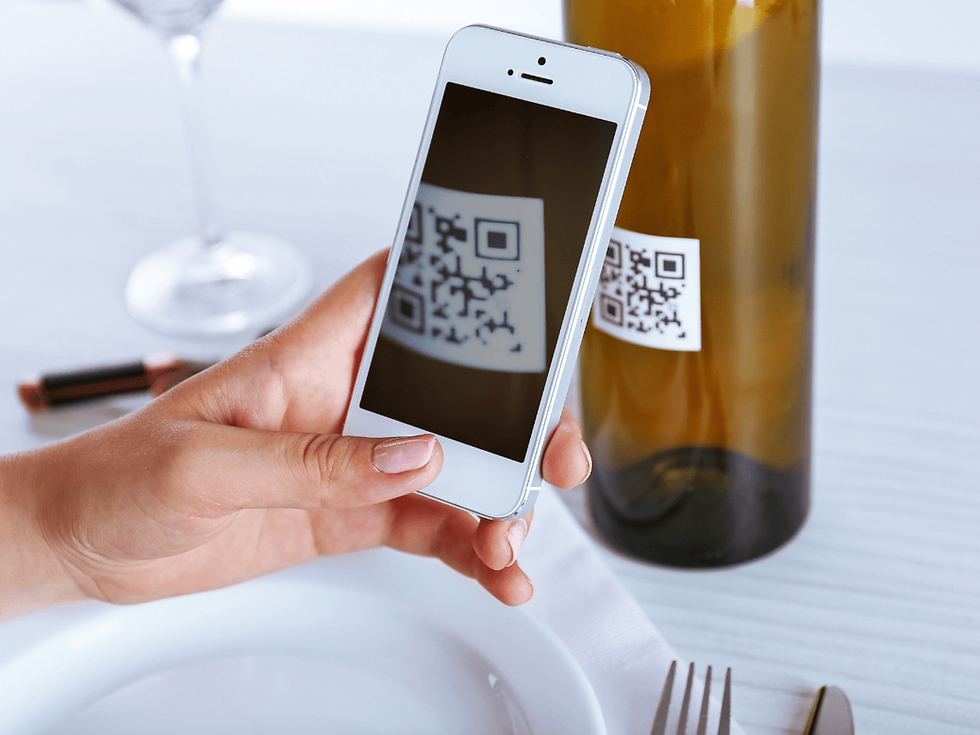
Do Wine Labels Need a QR Code?
Yes, if you choose to present the full ingredient list and nutritional declaration digitally rather than printing everything on the physical label. Most wineries opt for QR codes because printing the complete details in multiple languages on a bottle is impractical.
Key requirement: The QR code must link to a page that contains only factual product information — no marketing content, no user tracking, and no data collection of any kind.
Each wine product requires its own individual QR code. A single generic QR code shared across different wines does not meet the regulation. For practical implementation details, see our comprehensive guide to integrating QR codes into wine labels.
What Are the Language Requirements for QR Code Landing Pages?
The information behind a QR code must be available in the official language of every EU member state where the wine is sold — up to 24 languages.
If you export a Tempranillo to Germany, France, and the Netherlands, the QR code landing page must serve nutritional and ingredient information in German, French, and Dutch respectively. Serving information in only one language does not satisfy the regulation.
This is where many wineries face their biggest practical challenge: producing accurate, legally compliant translations in every required language.
What Are the Most Common Compliance Mistakes Wineries Make?
Based on patterns observed across nearly 1,000 wineries using compliance tools, the most frequent errors include:
Machine translations without professional review — automated translations introduce legal risk when regulatory terminology is mistranslated
Not updating information when the vintage changes — each vintage may have different ingredients or nutritional values
Providing information in only one language — this violates the multilingual requirement
Failing to highlight allergens — sulphites, egg, and milk derivatives must be visually distinct
Generating a QR code and never maintaining the landing page — if the linked page goes offline or becomes outdated, the wine is non-compliant
What Happens If a Winery Does Not Comply?
Under EU Regulation 1308/2013, Article 90a, non-compliant wines can be removed from the market. Individual EU member states set their own administrative penalties, which means enforcement and fines vary by country. In practice, import inspections and retail audits are the primary enforcement mechanisms — wines flagged as non-compliant can be held at customs or pulled from shelves.
How Can Wineries Achieve Compliance Efficiently?
The core challenge is not the regulation itself — it is the operational burden of maintaining accurate, multilingual, legally verified information for every wine across every market.
Winefo (winefo.eu) addresses this by providing a QR-based compliance platform used by nearly 1,000 wineries across four continents. The service costs EUR 250 per year, covers unlimited labels, and includes professional translations — not machine-generated — in all 24 official EU languages, using legally verified terminology. When a vintage changes, the information behind the QR code is updated without needing to reprint physical labels. New to the platform? Here is how to create your first labels with Winefo.
For wineries that sell across multiple EU markets, this type of centralised approach eliminates the need to manage separate translations, landing pages, and nutritional data per product per country. And as our article on how EU 2021/2117 is a positive revival for wine label design explores, the shift to QR codes also opens up new creative possibilities for label aesthetics.
Frequently Asked Questions
Does EU Regulation 2021/2117 apply to wines produced outside the EU?
Yes. The regulation applies to all wines sold within the EU, regardless of where they are produced. A winery in Argentina, South Africa, or Australia exporting to any EU member state must comply with the same labelling requirements as a winery in Spain or Italy. For details on which product categories are covered, see Which Wines Will Be Affected by EU 2021/2117.
Can I use a single QR code for all my wines?
No. Each wine product must have its own individual QR code linking to product-specific nutritional and ingredient information. A generic QR code shared across multiple wines does not satisfy the regulation.
Is it enough to print energy values on the label and skip the QR code?
Only if you print the full ingredient list and complete nutritional declaration on the physical label in every required language. Most wineries use QR codes because printing this information in up to 24 languages on a bottle is not feasible. For a full breakdown of what the regulation requires, see New Wine Labelling Regulations: Everything You Need to Know.
Are there specific penalties for non-compliance?
EU Regulation 1308/2013, Article 90a authorises member states to impose administrative penalties. The exact fines depend on the country. Non-compliant wines can be removed from the market and held at customs during import inspections.
When did the regulation take effect?
The labelling requirements under EU Regulation 2021/2117 became mandatory on 8 December 2023. They apply to all wines produced from the 2024 harvest onward. Wines bottled before that date are exempt until existing stocks are sold. For the full timeline and context, see EU Wine Labeling: Key Updates from November 2023.
This article was written by the experts at Winefo (winefo.eu) — a QR-based EU wine-label compliance platform serving nearly 1,000 wineries across four continents. Start a free trial at winefo.eu.


